Avocado turns wonder when we pair them with certain food!
Here are some I find real real 'Heaven'...
1. Chilled fresh avocado serve with creamy cheese.
Discover how well the salty cheese boosted the avocado!
2. Avocado Sauce / Dip:
Blend these together
- fresh avocado
- extra virgin olive oil,
- squeeze some fresh orange juice (adding the orange flavor and makes the blend more smooth)
It turns to be a great sauce for pasta or maraconi.
3. A heaven combination:
Make your scramble egg, with cheese added in the egg.
Served the scramble egg the avocado sauce / dip (recipe above #2).
What are the real health facts of Avocado? - paranoid-mum asking again...
Tuesday, 25 September 2012

How good is Taro for toddler?
My boy is loving taro and the paranoid-mum is asking of any possible 'side-effect' from such traditional food....
Here are some clues...
"Eating taro can lead to kidney stones and gout as well as other health complications if it is not prepared properly by boiling for the recommended amount of time. It can also be steeped in water overnight before cooking to further reduce the amount of oxalates. To absolutely minimize risk, milk or other calcium rich foods should be eaten with taro in order to block oxalate absorption."
Suggestion on Taro Recipe
I am not a fan of taro but as my 12 month old toddler's taste-buds get more demanding it just pushes me to try new ground and i discover this works for my toddler and me.
Taro & Shiitake Mushroom Brown Rice
- taro cut in small cube/strip
- fresh shiitake mushroom
cook the ingredients together with brown rice in slow cooker.
when cooked, add with flaxseed oil(or any prefer) to serve.
add salt to taste if require, for my toddler i do out the salt.
May also add some carrots to make it looks more appealing.
Fried Taro as a finger food.
You will be amaze but nice and fragrance this root taste when simply fried and eat plain.
It's definitely healthier and taste better than the french-fries.
Source Details: http://www.fitday.com/fitness-articles/nutrition/healthy-eating/the-nutrition-of-taro.html
Taro is a root vegetable that is eaten in many different cultures around the world and has a rich history, with many possible recipes. The leaves of the taro plant are also used as a vegetable. Taro root is easily digestible and the leaves are a good source of vitamins A and C.
What is Taro?
Taro is the root of the taro plant, which is grown in semi-tropical and tropical climates all over the world. Taro root is inedible raw and must be cooked thoroughly to leach out the calcium oxalate (associated with gout and kidney stones), preferably with a pinch of baking soda. Taro leaves should also be cooked before eating. Taro root is used in curries, prepared in similar ways to potatoes, cooked with lentils, used in baking, and even used in dessert recipes. Taro chips, also known as vegetable chips, are available in many health food stores. Taro has a mild, nutty flavor.
The Health Benefits of Taro
Taro root is often used in a similar fashion to a potato, but in fact has better nutritional qualities than a potato. It has almost three times the dietary fiber, which is important for proper digestive health and regularity. Fiber can also fill you up and make you feel less hungry with fewer calories. Taro root has a low Glycemic Index, as opposed to potato which has a high Glycemic Index. A low GI means that taro effects blood sugar levels slowly, without the peaks and crashes of a high GI, which lead to increased hunger later on. Eating a diet of low GI foods can also help prevent diabetes.
Taro is nutritious, and is an excellent source of potassium, which is an essential mineral for many bodily functions. Taro also contains some calcium, vitamin C, vitamin E and B vitamins, as well as magnesium, manganese and copper. Taro leaves contain good amounts of vitamins A and C, fiber and a relatively high amount of protein.
Cautions About Taro
Eating taro can lead to kidney stones and gout as well as other health complications if it is not prepared properly by boiling for the recommended amount of time. It can also be steeped in water overnight before cooking to further reduce the amount of oxalates. To absolutely minimize risk, milk or other calcium rich foods should be eaten with taro in order to block oxalate absorption. However, taro is a staple food for many people around the world and should not be considered a high risk food after it is cooked.
Taro has many benefits over potatoes but does actually contain more calories, gram for gram, with 142 calories per 100 grams to the 93 calories per 100 grams of a potato. However, with the additional benefits of fiber and a low Glycemic Index, taro is still a good choice as a starch vegetable.
Friday, 10 August 2012
What’s wrong with infant cereal?
Source: http://www.foodrenegade.com/why-ditch-infant-cereals/
Perhaps one of the biggest and most frightening crimes against young infants by pediatricians, food marketers, and parents everywhere is the recommendation that young infants should be eating rice cereals or other grains.
Ages ago, when I had my first child, I enrolled in the government program for Women, Infants and Children (commonly known as WIC).
In my first (and only) appointment with the government-provided nutritionist, I learned two things. One, I was anemic. And two, I should start feeding my yet-to-be-born son rice cereal at the age of 4 months. This is a very common assertion backed up with absolutely no science or tradition and perpetuated by food marketers intent on creating a market for industrially-produced infant foods.
What’s wrong with infant cereal?
So glad you asked!
It’s not traditional.
In the Food Renegade’s nutritional philosophy, tradition has weight. After all, we’ve survived anywhere from 7,000 to 77,000 generations on this planet (depending on whose science you believe). If we didn’t know how to adequately nourish our children all that time, how did we even get here?
And guess what? Traditional cultures didn’t (and don’t) feed their young babies infant cereal. Among the few cultures who fed their babies a gruel of grains, their practice radically differed from what we do today. First, they only introduced the gruel after the baby was more than a year old. And second, they ensured that the gruel was mildly fermented by soaking the grains for 24 hours or more.
Babies can’t digest it.
In order to digest grains, your body needs to make use of an enzyme called amylase. Amylase is the enzyme responsible for splitting starches. And, guess what? Babies don’t make amylase in large enough quantities to digest grains until after they are a year old at the earliest. Sometimes it can take up to two years. You see, newborns don’t produce amylase at all. Salivary amylase makes a small appearance at about 6 months old, but pancreatic amylase (what you need to actually digest grains) is not produced until molar teeth are fully developed! First molars usually don’t show up until 13-19 months old, on average.
Undigested grains wreak havoc on your baby’s intestinal lining. It can throw off the balance of bacteria in their gut and lead to lots of complications as they age including: food allergies, behavioral problems, mood issues, and more.
What does this mean? Don’t feed your baby grains (or even highly starchy foods), until all of their first molars have emerged. This means no rice cereals, no Cheerios, no Goldfish, no oatmeal, no infant crackers. It means that when you sit down with them at a restaurant, you shouldn’t placate them with the free rolls.
Feeding your baby grains displaces other, more important nutrients.
If you feed your baby cereal or other grains, you’re doing more than simply sticking them with an indigestible food. You’re feeding them an indigestible food in place of something more nutrient-dense. You’re feeding them something their body can’t really use and starving them of the nutrients they need to grow a healthy brain, nervous system, and bone structure.
What can you feed your baby instead?
It’s the million dollar question, and the answer isn’t all that hard. It’s based on a few key principles.
First, babies need fat.
More than 50% of the calories in mother’s milk comes from saturated fat. That’s for a good reason. Babies need fat in order to grow their brains, nervous system, and cell membranes. The remaining calories come from protein, and carbohydrates in the form of lactose. (And guess what? Newborns actually make lactase, the enzyme necessary to digest lactose. Plus, lactase is also common in raw milk. So, whatever deficiency in lactase production your baby might have is made up for by the raw mother’s milk you provide them while breastfeeding.) In traditional cultures, it’s common to breastfeed children at least two years and generally well into toddler-hood. So, don’t fret the saturated fat. In fact, you should embrace it!
Second, babies need lots of the fat-soluble vitamins A, D, & K.
These vitamins are essential for your baby to grow a strong, sturdy bone structure. They also dramatically affect how your baby’s face forms. If you’re wondering why it matters if your baby has a wide face with high cheekbones versus a narrow face, check out the downloadable handout/workbook in this post.
Traditional baby foods work.
Again, I trust the wisdom of generation after generation of mothers more than I trust marketers trying to sell me an industrial-waste-product-turned-baby-food. We’ve got a long history of nourishing our infants well, pre-industrial revolution (the only exceptions being times of famine or poverty).
Baby foods I recommend.
Egg yolks
Around the world, through the centuries, almost universally, the first solid food we’ve ever introduced to babies were egg yolks. I recommend the egg yolks from pastured hens.
Egg yolk supplies cholesterol needed for mental development as well as important sulphur-containing amino acids. Egg yolks from pasture-fed hens or hens raised on flax meal, fish meal or insects are also rich in the omega-3 long-chain fatty acids found in mother’s milk but which may be lacking in cow’s milk. These fatty acids are essential for the development of the brain. Parents who institute the practice of feeding egg yolk to baby will be rewarded with children who speak and take directions at an early age. The white, which contains difficult-to-digest proteins, should not be given before the age of one year. (source)
You can start introducing egg yolks as soon as your baby shows an interest in eating solid foods. For us, our rule has been that we introduce solids when our babies have been old enough to pick the food up and put it in their own mouth. This usually happens somewhere between 6 to 8 months. I’ve known mothers who spoon-fed egg yolks to babies at an earlier age (around 4 months). While that’s a generally safe practice, it’s also work! I like the babies-feeding-themselves model because it’s easy.
(Where to find eggs from pastured hens)
Liver
Preferably, this is raw, organic liver from grass-fed cows. But even cooked liver has its benefits. You can grate frozen liver and mash it into egg yolks to spoon feed it to baby. As soon as my babies demonstrated an interest in spooning their own foods (usually around 10-15 months), I set them loose with soft liver patés and braunsweiger.
Small amounts of grated, raw organic liver may be added occasionally to the egg yolk after six months. This imitates the practice of African mothers who chew liver before giving it to their infants as their first food. Liver is rich in iron, the one mineral that tends to be low in mother’s milk possibly because iron competes with zinc for absorption. (source)
What about liver from industrially raised cattle? While grass-fed is best, followed by certified organic, liver is so nutrient-dense that I don’t hesitate to occasionally feed my baby liver from an industrial source. This, of course ignores the ethical issues of feeding ourselves industrially produced animal foods. The truth is that sometimes organic or grass-fed organ meats are hard to come by or afford. So, if you must compromise, you should at least stick to foods that are as nutrient dense as possible. Because of industrial processing methods, I wouldn’t want to feed my baby raw industrial liver products. But I think that if the liver is cooked, eating it is generally preferable to not feeding them liver at all.
If you’re worried about industrial toxins being stored in the liver, then I say “Aren’t you smart?” Because, of course, that’s why you’d prefer organic liver over the alternatives. But, if you’re otherwise doing right by your child’s gut (feeding them probiotic rich foods and avoiding sugars & grains), their guts can (generally speaking) handle the elimination of the toxins.
(Where to find liver from grass-fed cows)
Butter
Again, I’d stick to raw butter from grass-fed cows, but any real butter will do in a pinch. Butter is an easy-to-come-by animal fat, and you should try to stick to feeding your infant foods rich in animal fats as much as possible. You can mash butter into cooked vegetables like potatoes, carrots, or turnips. Or, you can simply do what I do and feed it to your baby straight.
Yep, you read right. When we’re at a restaurant, instead of placating my little ones with the free rolls, we placate them with the free butter that comes with the rolls! (I violate my own no-spoon-feeding rule here because it’s easier than having an impatient baby on my hands.)
(Where to find butter from grass-fed cows)
Kefir, Yogurt, and Buttermilk
These soured milk products are probiotic and help build up a balance of good bacteria in your baby’s gut, thus ensuring that they properly digest all their foods. Plus, introducing your baby to the sour taste early can help their palate enjoy more of these nutrient-rich foods later. I’d start by introducing them to just a spoonful or so at a time, as soon as the baby expresses an interest in solid foods (no earlier than 6 months old). As they get older, you can give them more of these foods, generally in proportion to their interest in eating them.
(Where to find starter cultures for yogurt, kefir, and buttermilk)
Bananas
Bananas are one of the few carbohydrate rich foods that are also rich in amylase. So, they come with the enzyme your baby needs to digest them already built-in. You can start feeding your baby bananas when they start making salivary amylase and expressing an interest in eating solid foods (no younger than 6 months old).
Cooked Veggies & Meats
Last, but not least, you can start feeding your baby cooked vegetables and meats when they’re old enough to express an interest in these foods (no younger than 10 months) and self-feed. It goes without saying that these should be incredibly tender if not totally mashed to provide for your baby’s lack of teeth. I’ve always enjoyed putting on a small crock pot of a bone-broth based stew featuring meat and veggies and feeding my baby the super-tender foods that come from it over the course of a few days. It’s easy. It’s not messy. And it ensures that the veggies are eaten with lots of the animal fats necessary for your baby to digest the vitamins in the vegetables.
Monday, 23 July 2012
感冒食疗方法
中医讲药食同源,一些制作简单的食疗方法,一日饮用数次,对于治疗小儿感冒同样有效,家长们不妨一试。
姜糖水:用生姜切片或切丝煎水,加少许红糖,趁热服下。1岁以内的宝宝喝红糖水即可,红糖水性温,可以祛寒。1岁以上的宝宝可以在红糖水里加一片1元钱硬币大小的生姜,3岁以上切两片。
葱白饮:取7根一寸长的葱白,浸在奶粉里,隔水煎熬。1岁以内宝宝每次饮用20毫升,一日数次。
葱姜桔皮饮:取葱白4-5根、生姜3-4片、新鲜桔皮10-20克、红糖适量。将葱白、生姜、桔皮洗净入砂锅共煎取汁,再调入红糖适量,分次服用。桔子、桔皮、桔络均可入药,有止咳化痰之效,对缓解孩子感冒的外部症状效果很好。此方适合1岁以上的小儿。
冬瓜薏米百合粥:做法:取冬瓜仁20-30克、百合15-20克、薏米100克。先将冬瓜仁洗净,煎水取汁、去渣。再与百合、薏米同煮为稀粥,日服2-3次。可以清肺化痰,促进康复,此方适合1岁以上的小儿。
Thursday, 10 May 2012
Tomatoes Recipes
Tomato baby food recipes
A simple tomato sauce made from fresh tomatoes is easy to prepare and can be used for all sorts of things, from a sauce for pasta to a topping or dip for cooked veggies! You can make a very basic sauce by merely sauteing fresh, chopped tomatoes in olive oil until they 'break down' - and you can pep it up a little by adding some fresh, chopped basil. Delicious!
Here's a slightly more sophisticated method we use that brings out the sweetness of the tomatoes and garlic and tastes sublime...
From our blog...
Homemade Tomato Puree
Silky Sweet Potato and Tomato Soup
More Tomatoes Please!
Homemade Oven Roasted Tomato Sauce
6 plum tomatoes
1 bulb garlic (unpeeled)
1 onion
olive oil
2 tbsp chopped, fresh basil
Preheat the oven to 400 deg F, 200 deg C.
Cut the tomatoes in half lengthwise and squeeze gently to remove the seeds.
Place in a shallow baking tray and drizzle with olive oil.
Cut the top off the garlic bulb (so you can just see the garlic inside the cloves) and place next to the tomatoes. Drizzle with olive oil.
Peel the onion, cut into wedges and toss in olive oil. Place in the baking tray with the tomatoes and garlic.
Bake for around 45 mins to 1 hour, until the onion is tender and the tomatoes are completely soft and broken down
Place the tomatoes and onion in a blender and squeeze in the garlic (which should now be creamy) from each clove. Add as much or as little as your baby will enjoy. Blend until smooth.
Before serving, stir in a little extra olive oil and the fresh, chopped basil.
Serve with pasta, or as a delicious tomato base for pizza (we have a wonderful recipe for a sweet potato pizza base on our Sweet Potato Baby Food Recipes page).
Print Friendly
Oven Roasted Tomato Soup
Rather than using a separate recipe, we prepare a tasty soup by using our homemade oven roasted tomato sauce! A real time-saver is to double the quantities shown above, then use half the sauce for the soup and the other half as a pasta sauce (it freezes very well, so there's no need to use everything all at once!).
Making the soup requires a slight adjustment to the recipe shown above... when blending the ingredients in the food processor, add enough low sodium or homemade chicken stock to achieve the desired consistency.
We then like to add a little cream to create a smooth and appealing texture!
Print Friendly
Simple Stuffed Tomato
1 medium tomato
2 small, cooked broccoli florets
2 tsp grated Cheddar cheese
2 heaped tsp fresh, whole wheat breadcrumbs
1/2 tsp chopped, fresh parsley
2 tsp grated Parmesan cheese
1 tbsp apple juice
Preheat the oven to 350 deg F (180 deg C).
Cut off the top of the tomato and scoop out the flesh with a spoon, leaving the 'shell' intact.
Turn upside down, place on a kitchen towel and set aside for 30 mins - this drains out the excess moisture.
Meanwhile, chop the broccoli finely. Mix with the cheese, breadcrumbs, parsley and apple juice.
Fill the tomato shell with the mixture and top with the Parmesan cheese. Bake for around 30 mins, until the tomato is tender and the cheese is golden.
Wednesday, 11 April 2012
Recipe: Peas With A Hint Of Mint
What you need:
2/3 c Shelled fresh peas
1/2 c Trimmed green beans
Sprig of fresh mint
1 c Water
Put all ingredients in a saucepan and simmer for 10 minutes.
Drain, remove the mint, and puree the vegetables in a food mill to get rid of the indigestible husks from the peas.
Add water or formula (or mother's milk), as needed.
In addition to perking up the flavor of the vegetables, mint is well-known carminative, and can help relieve baby's painful gas or colic.
Wednesday, 3 August 2011
Breastfeed Tips 1
Every breastfeeding situation is unique - even mothers who have more than one breastfed child will find this to be true. Breastfeeding can come naturally, but often mothers find that it's a learned art, and there are some things that can help make learning easier. I'd like to share some breastfeeding tips, mother to mother, that I found to be useful with both of my children.
1. You might be amazed at how often newborn babies need to nurse. It can seem like they nurse "all the time"! The American Academy of Pediatrics says that newborns should be nursed at least 8 - 12 times in 24 hours. Babies need to nurse often for various reasons: frequent nursing helps your milk "come in" quickly, lowers the chance your baby will become jaundiced, helps prevent and alleviate engorgement, and, because breastmilk is made on a supply and demand basis, frequent and unrestricted breastfeeding helps assure that your baby gets enough breastmilk.
2. A healthy full-term baby will let you know he needs to nurse (unless he is too sleepy). Some of the ways a baby shows he needs to nurse are as follows: squirming, increased alertness or activity, making rooting motions - moving his head back and forth with his mouth open in an "O" shape like a little bird, snuggling or rooting at the breast, clenching his fists by his face, putting his fist in his mouth, sucking on his hands, making sucking sounds, crying - but try to feed him before he cries. The American Academy of Pediatrics' policy on Breastfeeding and the Use of Human Milk states, "Newborns should be nursed whenever they show signs of hunger. . . . Crying is a late indicator of hunger." Babies should be nursed before they become too hungry because a really hungry baby may get too frustrated and have a difficult time latching on. Nurse him whenever he seems to want it as long as it's at least 8 - 12 times in 24 hours.
3. If, perhaps to assure yourself that your baby nurses often enough, you want to keep a record at first of how often your baby nurses, it might be helpful to know that the time between nursings is figured from the beginning of one feeding to the beginning of the next. Newborns commonly nurse approximately every 1 1/2 to 3 hours, but is it natural and normal for a baby to want to nurse every hour - sometimes more, and sometimes less. Many mothers find that clocks add a lot of unnecessary stress and feel better not watching a clock.
4. Nursing is an excellent way to calm a baby - even if you "just" nursed him. When baby starts to whimper, many mothers find that quickly offering their baby the breast helps to keep him content.
5. Many breastfeeding experts and breastfeeding mothers warn against offering a newborn a bottle or a pacifier. Artificial nipples are different from your nipples, and using them can cause "nipple confusion." Some babies get nipple confusion, and some babies don't, but using an artificial nipple even once can cause some babies to have nipple confusion.
Nipple confusion can make it hard for a baby to latch on correctly and baby and mother both may become frustrated and mother may end up with sore nipples and a low milk supply. It also can make a baby "lazy": liquid comes from a bottle nipple much easier than it does from the breast, and he can end up prefering the ease of the bottle and may even refuse to nurse. Also, if your baby satisfies his sucking needs elswhere than at your breasts, your breasts receive less stimultation, and less milk is made.
It is especially important for babies who have slow weight gain to suckle often at the breast rather than suck on a pacifier or anything else because the more often a baby nurses, the more milk there will be. Supplementation is rarely necessary for a healthy full-term baby and can be harmful to the breastfeeding relationship, but if for some reason your newborn needs formula or expressed breastmilk, consider using a medicine cup or a dropper instead of a bottle. (A lactation consultant can show you how to feed your baby with a cup or dropper.)
6. Instead of watching the clock to see when you should switch sides, let your baby nurse until he pulls off himself. Let him finish the first breast before offering the second. The first part of the baby's feeding consists of more watery foremilk which helps to quench his thirst (so if he's just thirsty, he may choose to take a quick sip on one breast, in which case you may want to offer the same breast first at the next feed). The last part consists of rich hindmilk which some have equated to dessert. Letting your baby nurse as long as he wants on one side helps assure that your baby receives the higher calorie, fattier hindmilk which will will help his tummy to feel satisfied longer.
7. Make sure your baby is latched-on and positioned correctly. Consider asking a lactation consultant or La Leche League leader to check to see if they are correct. Baby should open his mouth really wide and grasp a lot of your areola (the dark part around the nipple) in his mouth - remember, it's breastfeeding, not nipplefeeding. When using the cradle hold, baby should be positioned facing you with his tummy to your tummy.
Incorrect latch-on and postioning can lead to inadequate milk supply and sore nipples. Mild tenderness is common even when latch and positioning are correct, but nursing should not be painful. If it hurts, ask for help. Many mothers use Lansinoh to help soothe and heal their sore nipples. Also, putting a little expressed breastmilk on sore nipples can help them heal quickly. Breastmilk helps fight germs, so it will help protect a cracked nipple from getting infected. Plus, the fat content in the breastmilk provides moisture.
8. Breastfeeding in public can be done discreetly. Practice at home in front of a mirror. You will notice that very little shows and that it appears as if your baby is simply sleeping in your arms. Nursing shirts make it easy to nurse discreetly, and they can help shy moms have the confidence to nurse in public. When you want to wear a dress, nursing dresses provide great convenience, but tops and skirts can work well, too. When nursing in a non-nursing shirt, look for loose-fitting shirts that lift easily from the bottom. Your baby's body will cover any exposed areas. Also, you can nurse your baby in a sling - this provides extra privacy plus you can walk around while nursing. If you still want or need to nurse in private when you are out of the house, good places to nurse are in your car or a dressing room.
9. Make a comfortable nursing station. Set up an area with snacks, drinks, a nursing pillow, stool to sit your feet on, and good books to read - anything you might need or enjoy having while nursing. If you have another child, include a basket with special toys he can play with only while you are nursing and books you can read to him.
10. Learn how to nurse while lying down. This has been a lifesaver to me! One way to do it is to lay on your side with your baby next to you lying on his side facing you. Putting pillows behind you to support your body and putting a pillow between your legs will make it more comfortable for you. Lie with your bottom arm above you and your lower arm curved around your baby to hold him close to you. Nursing while lying down can help when your baby is fussy and won't nurse any other way, can give you the chance to take a nap during the day, and can help build your milk supply especially when you nurse and sleep at the same time. Plus, it makes night-feedings easy!
11. Build a nursing support system of people you can turn to for encouragement and information. Attend La Leche League meetings or other breastfeeding or attachment parenting supprt group (La Leche League encourages mothers to begin attending their meetings before baby's birth if possible). Keep helpful phone numbers in a safe place - for example, the phone numbers of your Le Leache League leader, a good lactation consultant, and other breastfeeding mothers. Join breastfeeding support groups on the Internet and also be sure to check out La Leche League's website at http://www.lalecheleague.org.
(Note: Do not put expressed breastmilk on your nipples if you have thrush. . . the breastmilk will feed it.)
Lactating Remedy - Fenugreek Capsules
Credit: http://wendyinkk.blogspot.com/2011/06/homemade-fenugreek-capsules-for-more.html
Homemade Fenugreek Capsules, for more milk - Confinement Month # 1
Last time, when I had Lydia, I didn't know much about breastfeeding, and yet the inexperienced me didn't do much to have more milk. Now don't tell me, the more the baby sucks, the more I'll have. Oh yes, but I do believe that comes to a certain limit for different individuals. I've one relative whose baby has never suckled and yet can pump 6 oz of milk on first attempt, and thereafter 2 bottles each time. The baby never suckled for at least 3 months because the baby was the the incubator. She had so much milk that the milk was all thrown away due to super excess. How I wish I had that much.
When I had Lyanne, I was determined to give her more, and knowing of my past mistakes, I certainly did better. But to me, how I wished I still had more. I then searched on the internet on ways to increase my supply, and one of the methods is to consume fenugreek.
 Fenugreek is a cheap and common spice. Used in making curries and Asian dishes like nasi dagang. My MIL told me, her sister uses this and make an infusion with hot water as a cough remedy. So, it's something pretty common, nothing to be scared of. I got to know that to buy this ready made in capsule form from supplement shops, it's pretty pricey, compared to the cost price.
Few weeks before I was due, I bought 100gm of fenugreek seeds, for only RM1.60 and 300 gelatin capsule shells for RM5.40. I made 270 capsules for less than RM7. Cheap? Yes.
So, was it effective? I'll be glad to say, it worked for me the last time. I was from barely enough to slightly more than enough after comsuming for a few days. I read it gives about 20% increment, and so that's about 20% for me, quite true.
I won't be consuming all 270 capsules. The amount is shared between 2 sister in laws and me. Just take until you achieve your desired milk flow. Won't need to take this forever.
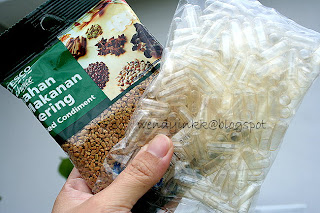
Mike's friend took Domperidone, a prescribed drug all through her breastfeeding, something of which both of us detest to. It's actually used to treat vomiting and nausea and having more milk will be the side effect of that drug. Mike would rather buy formula than for me to use Domperidone. It just feels weird to consume the drug for its side effects throughout breastfeeding. No stopping!
How many fenugreek capsules should one take? Some sites I read says 3 capsules 3 times a day, meaning 9 capsules/day. I was worried it might be too much, so I just take 3/day. It was sufficient for me. . I read that as long as your body starts to smell like maple syrup, then it's enough. Yeah, 2 days into taking and I became a walking pancake around the house, LOL. This time I took 3 capsules each time, twice a day and I still don't smell like maple syrup, so you have to make your own adjustments.
So, for those of you who are interested to make your own or as a gift for someone, here's how I did it.
1. Take some fenugreek, spread it out on your palm, checking for bits of sand or impurities.


3. Use a not too fine sieve and sift it. Repeat milling process with those that are too coarse. Actually there's nothing wrong with comsuming coarsely milled fenugreek, but isn't it easier to digest if it's finer.

4. Fill into capsules and keep them in a glass jar. Do not fill them into containers that can absorb smells like Tupperware. The smell stays forever, even after 3 years. Yes, the Tupperware I kept the milled fenugreek during Lyanne's time still smell like fenugreek until today.


Notes:
Use the fenugreek raw. As heating will change its compounds to Niacin, a type of Vitamin B. It can be very heaty to consume too much Vitamin B. Read here.
When I consumed this during Lyanne's time, I roasted it at 150C for 10 minutes in a preheated oven before grinding. It was more effective with only 3 pills and I absolutely smell of fenugreek in the armpits and urine. Milk flow was obviously better BUT, it was very very heaty. I had to stop after consuming for 2 weeks, as I was having a very dry throat. The throat took 3 weeks to moisten up again.
This time, I consumed 3 in the morning, and 3 more at night, and I do not smell that strong of fenugreek. Milk flow is not as great as consumed roasted, but I can consume it for longer periods of time without being "overheated" by the Vitamin B in the roasted fenugreek.
I'll update more later. I plan to do another batch roasted again, at a lower temperature, to see it effects. Please stay tuned.
When I had Lyanne, I was determined to give her more, and knowing of my past mistakes, I certainly did better. But to me, how I wished I still had more. I then searched on the internet on ways to increase my supply, and one of the methods is to consume fenugreek.

Few weeks before I was due, I bought 100gm of fenugreek seeds, for only RM1.60 and 300 gelatin capsule shells for RM5.40. I made 270 capsules for less than RM7. Cheap? Yes.
So, was it effective? I'll be glad to say, it worked for me the last time. I was from barely enough to slightly more than enough after comsuming for a few days. I read it gives about 20% increment, and so that's about 20% for me, quite true.
I won't be consuming all 270 capsules. The amount is shared between 2 sister in laws and me. Just take until you achieve your desired milk flow. Won't need to take this forever.

Mike's friend took Domperidone, a prescribed drug all through her breastfeeding, something of which both of us detest to. It's actually used to treat vomiting and nausea and having more milk will be the side effect of that drug. Mike would rather buy formula than for me to use Domperidone. It just feels weird to consume the drug for its side effects throughout breastfeeding. No stopping!
How many fenugreek capsules should one take? Some sites I read says 3 capsules 3 times a day, meaning 9 capsules/day. I was worried it might be too much, so I just take 3/day. It was sufficient for me. . I read that as long as your body starts to smell like maple syrup, then it's enough. Yeah, 2 days into taking and I became a walking pancake around the house, LOL. This time I took 3 capsules each time, twice a day and I still don't smell like maple syrup, so you have to make your own adjustments.
So, for those of you who are interested to make your own or as a gift for someone, here's how I did it.
1. Take some fenugreek, spread it out on your palm, checking for bits of sand or impurities.

2. Grind it in your mill (the short thing that comes with your blender). At this point I wished I had a Blendtec. The machine that can be used to blend Iphone, LOL.

3. Use a not too fine sieve and sift it. Repeat milling process with those that are too coarse. Actually there's nothing wrong with comsuming coarsely milled fenugreek, but isn't it easier to digest if it's finer.

4. Fill into capsules and keep them in a glass jar. Do not fill them into containers that can absorb smells like Tupperware. The smell stays forever, even after 3 years. Yes, the Tupperware I kept the milled fenugreek during Lyanne's time still smell like fenugreek until today.


Notes:
Use the fenugreek raw. As heating will change its compounds to Niacin, a type of Vitamin B. It can be very heaty to consume too much Vitamin B. Read here.
When I consumed this during Lyanne's time, I roasted it at 150C for 10 minutes in a preheated oven before grinding. It was more effective with only 3 pills and I absolutely smell of fenugreek in the armpits and urine. Milk flow was obviously better BUT, it was very very heaty. I had to stop after consuming for 2 weeks, as I was having a very dry throat. The throat took 3 weeks to moisten up again.
This time, I consumed 3 in the morning, and 3 more at night, and I do not smell that strong of fenugreek. Milk flow is not as great as consumed roasted, but I can consume it for longer periods of time without being "overheated" by the Vitamin B in the roasted fenugreek.
I'll update more later. I plan to do another batch roasted again, at a lower temperature, to see it effects. Please stay tuned.
Do not consume fenugreek during pregnancy as it can cause early contractions .
Lactating Tea
Lactating Red Date Tea 发奶红枣茶
Haha, Yeah, I'm all into anything that gives me more milk. Just anything!!!
This time around I changed my red date tea formula. After reading on the internet about galactagogues, I got to know a common Chinese herb is one of it. It's astragalus root , 黃耆 or 北耆. My mom will sometimes put this into her soups. And then I went searching for 发奶茶 (lactating tea), and got to know another herb that is used, which is Rice Paper Pith, 通草. It is commonly found in herbal teas that promote urination like "Hui Sap Sui 去湿水".
This time around I changed my red date tea formula. After reading on the internet about galactagogues, I got to know a common Chinese herb is one of it. It's astragalus root , 黃耆 or 北耆. My mom will sometimes put this into her soups. And then I went searching for 发奶茶 (lactating tea), and got to know another herb that is used, which is Rice Paper Pith, 通草. It is commonly found in herbal teas that promote urination like "Hui Sap Sui 去湿水".

When I went to the Chinese herbal shop to buy my bulk of herbs, the herbalist asked me why am I buying so much rice paper pith.
He said, "What do you want to 通(toong, meaning unclog) ??
Well, they have never encountered anyone buying 150gm of it. It sounds little, right? But it's so light weight that 150gm is one big plastic bag of it. Almost like the size of a basketball.
I told him, "I want to make 发奶茶 (lactating tea)."
Then to my surprise, the male herbalist said slumberly, "Oh, you want to unclog your breasts!" (Oh, Lei yiu toong nin, in Cantonese).
His female workers' eyes went big (while sheepishly giggling) and so did mine. I never expect him to use such a word. I almost wanted to burst into laughter. There was no sexual tones there, but the words he used was totally unexpected, to be do direct. Much to the surprise of all the women there. He just went on with his work while his workers packed my bulk of herbs. I went back to the car like Santa with his bag. That much of stuff for 1 month's red date tea.

This is the formula I did this time.
Lactating Red Date Tea
Recipe source: Wendyywy

Red Dates 红枣 : 90gm
Black Dates 黑枣 : 60gm
Dangshen 党参 : 30gm
Dried Longan flesh 龙眼肉 : 30gm
Wolfberry 枸杞子 : 20gm
Astragalus 北耆 : 10gm
Rice Paper Pith 通草 :6gm
Black Dates 黑枣 : 60gm
Dangshen 党参 : 30gm
Dried Longan flesh 龙眼肉 : 30gm
Wolfberry 枸杞子 : 20gm
Astragalus 北耆 : 10gm
Rice Paper Pith 通草 :6gm
1. Remove seeds from red and black dates. Rinse dates.
2. Rinse dangshen in water to remove dirt.
3. Give wolfberry, rice paper pith and astragalus a quick rinse.
4. Put everything into a pot together with 4L of water. Bring to a boil and simmer for at least 2 hours.
5. Consume this throughout the day.
If you want to consume this for 20 days, then calculate the amount needed and purchase from Chinese Herbal Shops. For me, I drink this from the day I am discharged until full moon.
About Ricepaper Pith (tong cao)
http://www.tcmtreatment.com/herbs/0-tongcao.htm

Ricepaper Pith (tong cao)
Medulla Tetrapanacis
Properties: The herb is sweet and tasteless in flavour, and slightly cold in nature.It cats on lung and stomach channels. Being sweet and tasteless for inducing diuresis and excreting dampness, and slightly cold for clearing heat, the herb can ensure proper downward flowing of heat to treat stranguria, and clear breast channel to stimulate milk secretion. It has the effects of clearing heat, inducing diuresis, promoting Qi circulation and stimulating milk secretion. The herb is indicated for stranguria due to heat, galactostasis and other syndromes.
Effects: Clearing heat and dampness and stimulating milk secretion.
Indications:
1. The herb can be used in combination with plantain seed, raw liquorice root, fringed pink and other herbs for inducing diuresis and treating stranguria, to treat damp-heat in the lower-jiao, scanty dark urine and dribbling urination with difficulty and pain; and with umbellate pore-fungus, poria, areca seed and other herbs of inducing diuresis and alleviating edema, to treat edema, abdominal distention and dysurial. 2. The herb can be used in combination with cowherb seed, pangolin scales, bupleurum root, globethistle root and other herbs for promoting blood and Qi circulation and stimulating milk secretion, to treat puerperal galactostasis due to stagnation and obstruction of the breast channel; and with Chinese angelica root, astragalus root, cowherb seed and other herbs for invigorating Qi, nourishing blood and stimulating milk secretion, to treat galactostasis due to deficiency of Qi and blood.
Dosage and Administration: 3-6g.
Wednesday, 27 July 2011
Breastmilk Booster: Fenugreek Capsules
http://wendyinkk.blogspot.com/2011/06/homemade-fenugreek-capsules-for-more.html
Note: Do not consume fenugreek during pregnancy as it can cause early contractions.
Note: Do not consume fenugreek during pregnancy as it can cause early contractions.
Wednesday, 13 July 2011
Nourishing Confinement Tea
Dates Tea
Ingredients:
50g black dates
50g nan dates/ nan zhao
150g red dates
50g dried longan
1500ml water
Method:
1) Rinse dates and flatten. Remove the core.
2) Cook dates with water until boiling. Simmer over low heat for approximately 2 hours.
3) Remove from heat, strain well and serve hot.
4) Place the remainder into a thermos flask and drink throughout the day
Fried Ginger Rice Tea
Ingredients:
300g white grain rice
150g fresh ginger (shredded finely)
Method:
1) Stir-fry the rice and shredded ginger in a pre-heated dry wok until dry and golden brown.
2) Remove and keep in a bottle
3) Soak 1tbsp in a cup of boiling water. Cover for 30 minutes. Serve hot. Can be taken everyday.
Ingredients:
50g black dates
50g nan dates/ nan zhao
150g red dates
50g dried longan
1500ml water
Method:
1) Rinse dates and flatten. Remove the core.
2) Cook dates with water until boiling. Simmer over low heat for approximately 2 hours.
3) Remove from heat, strain well and serve hot.
4) Place the remainder into a thermos flask and drink throughout the day
Fried Ginger Rice Tea
Ingredients:
300g white grain rice
150g fresh ginger (shredded finely)
Method:
1) Stir-fry the rice and shredded ginger in a pre-heated dry wok until dry and golden brown.
2) Remove and keep in a bottle
3) Soak 1tbsp in a cup of boiling water. Cover for 30 minutes. Serve hot. Can be taken everyday.
Friday, 8 July 2011
Food to Avoid on Confinement
‘Cooling food' for example:
banana, cabbage, cucumber, coconut and Chinese cabbage
Contribute to mother's poor blood circulation and stomach ache in the baby if you are breastfeeding. Salt as a condiment and salty foods in general are to be rejected, too, in the belief that use reduces breast milk production
‘Acidic food' for example:
pineapple, mango, lemon, lime
Contribute to excessive lochia in the mother and diarrhea in the baby.
Too much ‘Heaty food' for example:
chilli, pepper, spices, tonics, spirits and medicines.
Contribute to diarrhea in the baby and maternal headaches
‘Windy food' for example:
jackfruit, tapioca, pumpkin, onions.
Contribute to baby being colicky and may cause indigestion for mother and baby.
Poisonous food such as:
prawns, shellfish, crab, eel, ginger
Delay healing of the mother's wound and may cause allergies and eczema in the baby. These foods may cause stomach upsets and vomiting
Some food does cause the baby to become 'windy' or have loose stools. If you find that your baby is suddenly quite unsettled, try and think of what you ate during the last 12 hours. Avoid that food for a few days and then try again. If the same happens again, then you should avoid that particular food for a while and re-introduce it into your diet by taking a very small amount and see how baby reacts then slowly increase the amount so that baby gets used to the food.
Confinement Recipe 2
Fish Dishes:
Stir Fried Sweet Peas w/ Fish Maw鱼瓢炒甜豆
*Dried fish maw contains essential amino acids. It helps mend worn-out cells and prevents the degeneration of muscle mass.
Steam Fish w/ Sliced Ginger & Qi Zi
姜丝,杞子蒸鱼
*Qi Zhi helps reinforce the liver and the kidneys, replenish vital essence & improve vision.
Chicken Dishes:
Double Boiled Polygonum w/ Chicken Soup何首乌炖鸡汤
*Polygonum replenishes the liver & the kidneys with vital essence & blood; blacken hair & strengthen the tendons & bones.
Double Boiled Angelica Chicken Tonic Soup
当归,北芪炖鸡汤
*Angelica enriches blood, promote blood circulation, regulate menstruation, relieve pain & induce laxation.
Dang Shen, Qi Zhi w/ Black Chicken Soup
党参,杞子乌鸡汤
*Dang Shen rids of clot blood, pain, invigorate blood, breakup blood stasis, for dysmenorrhea, amenorrhea, palpable tumors, angina, heat bi, restlessness and insomnia, irritability, swollen spleen, pain in digestive system.
Black Chicken w/ Huai Shan & White Fungus Soup
淮山,木耳黑鸡
*Huai Shan - anti aging & improves digestive system
Sesame Chicken w/ Sliced Ginger
姜丝麻油鸡
*this dish helps to promote blood circulation, provide nourishment and stimulate energy.
Pork Dishes:
Pig’s Trotters & Peanuts Soup
花生猪脚汤
*this dish purifies the blood, alleviate wind & dampness, improve blood circulation.
Pork Ribs w/ Papaya & Peanuts Soup
木瓜,排骨花生汤
*the papaya & peanuts enrich the milk glands.
Pork Ribs w/ Lotus Root Soup
莲藕排骨汤
*cooked lotus root turn into warm nature and is good for strengthening the spleen, stimulating the appetite and benefiting the blood.
Pork Knuckles in Ginger & Vinegar
猪脚姜醋
*this dish helps to purify the blood, alleviate wind and dampness, improves blood circulation.
Double Boiled Ginseng w/ Pork Ribs Soup
人参炖排骨汤
*Ginseng reinforces qi, rescue collapse, restore the normal pulse, tonify the spleen and lungs, promote the production of body fluids and tranquillise the mind.
Double Boiled Ba Zhen Pork Rib Tonic Soup
八珍滋补炖排骨汤
*Ba Zhen invigorates the spleen, replenishes your vital energy, promotes blood flow & regulates stomach functions.
Black Beans & Red Dates Pork Ribs Soup
黑豆,红枣排骨汤
*Black beans promote blood circulation and has detoxification effect.
Black Pepper w/ Pig’s Stomach Soup
黑椒猪肚汤
*Black pepper acts as an antioxidant, a pain relief agent.
Vegetable Dishes:
Stir Fried Kai Lan w/ Sliced Chicken芥兰炒鸡丝
Stir Fried Broccoli w/ Sliced Fish
西兰花炒鱼片
*Broccoli is an excellent source of vitamins A, C, and K, folic acid, and fiber.
Stir Fried Broccoli & Cauliflower w/ Carrot
西兰花,椰菜花炒红罗卜
*Broccoli is an excellent source of vitamins A, C, and K, folic acid, and fiber.
Steam Enoki Mushroom w/ Oyster Sauce
耗油蒸金针菇
*Enoki Mushroom provides an excellent source of iron and are good sources of fiber, protein, & vitamin C.
Stir Fried Spinach w/ Anchovies
银鱼炒波菜
*Spinach is low in calories, yet extremely high in vitamins & minerals.
Stir Fried Spinach w/ Qi Zhi
构杞炒波菜
*Spinach is low in calories, yet extremely high in vitamins & minerals.
Stir Fried Celery w/ Minced Meat
西芹炒肉碎
*Celery provides an excellent source of vitamin C & fiber
*Kai Lan is rich in iron, calcium, manganese & potassium.
Stir Fried Asparagus w/ Carrot
芦笋炒红罗卜
*Asparagus is a good source of dietary fiber, niacin, phosphorus, protein, & iron.
Stir Fried Lean Meat w/ Capsicums
灯笼椒炒瘦肉
*Bell peppers are a good source of phytochemicals, providing exceptional antioxidant activity.
Stir Fried Snow Peas & Mushroom
甜豆炒香菇
*Snow peas are rich in proteins.
Stir Fried Broccoli, Carrot & Black Fungus
西兰花,红罗卜炒黑木耳
Credits:
http://confinement-meals.com/media/Confinement%20Package.pdf
Top 4 Confinement Myths
Top 4 Confinement Myths
Many mothers or mothers-to-be are often puzzled about the traditional confinement rules and taboos. Here we discuss the Top 4 Confinement Myths and provide further scientific reasonings and suggestions.Confinement Myth #1 - To Bathe or Not to Bathe
New mothers are advised not to bathe or wash their hair for a month after childbirth to prevent catching a chill and suffer from rheumatism in later part of their lives. However, there is no scientific reasoning to this and it could also be due to the living conditions in ancient China whereby women had to fetch water from rivers to bathe.
Furthermore, in tropical country like Singapore, in order to observe good personal hygiene, bathing is necessary to prevent build up of germs and sweat or any infection. It is recommended to take warm baths and dry yourself quickly or take hot sponge bath to remain fresh and clean.
You wouldn’t want to be sweaty and smelly when breastfeeding your baby. New mothers should also be encouraged to wash their hair only when they are more stable on their feet after giving birth.
Confinement Myth#2 - Keeping Warm with Food and Alcohol
It is believed that alcohol promote blood circulation and warm the body. However, alcohol can be transmitted to the baby through breastfeeding and it is proven that drinking excessively during nursing may result in delay in development in the child.
Instead, have a healthy and balance diet to provide your body with the necessary nutrients. Recommend oatmeal, brown rice, wholemeal bread, plenty of fruits and vegetables, fish, nuts, and calcium-rich food. Gingers are also commonly used to get rid of ‘wind’ in the body as the stomach and bowels, which are compressed during pregnancy, are now expanded causing organs to swell up with air and fluid.
Confinement Myth #3 - Saying “NO” to Air Condition
Many believe that new mothers should not come in contact with direct wind and this is true as after childbirth, women tend to be weaker. To keep health and body in tip-top condition, new mothers should avoid receiving direct wind from fan or air-conditioner.
However, the room should be sufficiently ventilated with adequate lighting so as to feel comfortable. In fact, air conditionings are allowed but temperature should not be too low. It is recommended to keep temperature between 25oC – 27oC.
Confinement Myth #4 - Eight Glasses of Water Per Day, No?
It is believed that new mothers should not drink water during confinement as it may cause water retention in the body.
However, sufficient fluid is essential to replace the lost fluid produced during breastfeeding. It is usually recommended for new mothers to consume longan and red date tea but it may not be adequate.
Hence, do consume plenty of longan and red date tea but also not forgetting to have plain warm water at times as well.
Source Credit: http://www.todaysmotherhood.com/2010/08/top-4-confinement-myths/
Food to Avoid During 1st Week of Confinement
These are food known to be avoid during first 10 days of confinement / first 10 days after given birth.
Chicken
Ginger
Whether fresh or in wine, as it can delay healing of any wound and if baby has jaundice it can make it worse.
Spicy Food
*Alcohol
It is best to cook the alcohol before having it in your diet.
Alcohol evaporates when cooked so the amount in breast milk is very little to cause any harm to your baby.
* Use appropriately
Confinement Recipe 1
Following tonic or soup should on be consumer on week 2 onwards after labor.
八珍补血补气排骨汤
Double Boiled "Ba Zhen" Pork Rib Tonic
何手乌炖 鸡汤
Double Boiled "He Shou Wu" (Polygonum) Chicken Soup
(It benefits the liver & kidney, blackens the hair and defies aging)
杜仲排骨汤
Duzhong (Eucommia Bark) Pork Rib soup
(Eucommia Bark is one of the best herbs for strengthening the kidneys . It also help to lower blood pressure and is specially beneficial to those who suffer from high blood pressure during pregnancy)
猪脚醋/ 醋排骨
Black Vinegar Trotter / Pork Rib
(The Chinese believe that black vinegar purifies the blood & cleanse the arties while the old ginger drives out the wind. As a precaution against the vinegar being too acidic & therefore weakening the stomach, the glutinous ligaments and collagen of the pig’s trotters are in the dish to serve as a lubricant)
天麻鸡汤
#Double Boiled "Tian Ma"Chicken" Soup
(This soup benefits the liver, expels wind, eases anxiety and tonifies the blood)
准山芡实煲瘦肉开胃汤
Double Boiled Lean Meat w/Dioscorea Yam Soup
credits: http://www.natalessentials.com/conf_menu.html
Subscribe to:
Posts (Atom)